Social Icons

Pages

Se afișează postările cu eticheta healthy. Afișați toate postările

Rose Jam


Rose Jam


Ingredients:


-250 grams rose petals
-1 kg of sugar,
-1 liter water
-2 lemons,
-cinnamon (crushed, not powdered!) optional
-2-3 sachets vanilla sugar


  Method:


First, it's good to know what kind of roses you have to choose. As a general rule, the best are (in this order) rosy pink, white and yellow. Red roses are to be avoided, except very fragrant.
A second rule: the flowers should not be too old, or fade (use flowers with petals fine, not thick).
Finally, the third rule says that each flower must be fragrant (do not use roses that have a perfume smell vaguely or not at all).


Do not worry, it's not so hard as it seems!
Secondly, you should do get rose petals, just not easy job.
So now assume that you have about 250 grams of petals.
Follow the unpleasant job, namely peeling the white petals (which are attached to the stem), so that the composition gives a bitter taste. It's a painstaking matter, because you need to take petal by petal.
But if you have all the flower bulb, you can break all the petals first time, separating them from the useless.
Well, now let's see what ...
Mix by hand, not easy to break, all petals with juice from a lemon (lemon is to preserve the sweetness and consistency to keep the petals).
You should not take petal by petal, but put all the petals in a saucepan, pour over juice, and mix thoroughly, rub hands while petals.
Separately, in an enamel pot, boil about a quart of water and sugar.
When it starts to boil put rose petals that have been rubbed with lemon. Let it boil for about an hour - an hour and a half - this according to how "low" want to do (ie how much you want to have honey syrup).
In any case, you should be aware that a too low sweetness (not too much syrup) is extremely sweet, whereas too much syrup sweetness will not hold too much (you have to be refrigerated and eaten in two or three weeks, because you will not "in winter"). Obviously, the ideal would be to make a jam between the two extremes. During boiling, obviously chew from time to time, do not catch the pot. Time is one about, honey is taken off the heat when it is "connected". With about 10 minutes before taking from the fire add sweetness to the other lemon juice and cinnamon. Once ready, they move away from the fire, and put the hot jam into jars directly.

Rose multiplying

Rose multiplying

Both nobles and those wild roses can be propagated by seeds (sexual) and fragments of plants (asexual).
Propagation by seed is practiced when seeking or obtaining stock in research units in order to obtain new varieties, hybrids, etc..
Seeds best suited for this purpose are those of the brutal briar.
On a sloppy field since spring deep longer applies once subsoiling 35-45 cm in June aimed at both the loose soil and remove weeds as developments. Before sowing, the land will be raking, weed nivelet and dry cleaning. When you begin to yellow currants are picked and mash with a wooden rollers or a pestle.
The material itself is sown, in rows spaced 30-40 cm. Sowing depth is 4-5 cm, and is made in trenches made with hoes. Above seeds put a 4-5 cm layer of soil that press it with a piece of wood. Manure would be the best but, failing that use a light soil, permeable. For protection against very low temperatures of winter that follows, above rows will sit a layer of straw or other dry plant.


In spring straw is removed and semanaturii see results. If seedlings are springing too although they can be transplanters. Subculturing is done when soil moisture allows uprooting plants without injury when they have 3-4 leaves. Replanting will be done on a well prepared soil. In summer, the seedlings will be hoeing, wet, trim. After the first frost, seedlings will be removed, sorted and categorized.
The most vigorous seedlings, 5-7 mm in thickness to the parcel will be replanted in pots, in the period immediately following their removal, and shall be grafted and replanted in June-July next year. Grafting is indicated in the eyes, not the eyes increasing sleeping. Feeblest sapling will follow the same procedure but grafting is recommended for her sleeping eyes (July-August).

Cutting roses

 
Cutting roses

This is done considering the group they belong and plant age. It is best to do this operation annually by the same person that thinks the crown formation in perspective and makes some compromises moment and will take definitive steps you are able to choose.
Cutting technique is not difficult and can make anyone knows a few basic elements. The group Thea noble roses, young plants can leave 1-2 years 3-4 sprouts will form the basis of the main frame. These shoots are cut, to drill "3-4 buds if vigorous varieties.
In the coming years will gradually leave on a bush 5-8 drill, remove all interior increases to achieve a bush and airy and well lit to facilitate our work to the next cut. Sometimes it is impossible to cut a tenon mature, dry, surrounded by other fit to keep. Usually remove extra shoots from the base, or the thin, those with interior and of course the increase in dry or frozen.

 Sectioning is above a bud facing outward or lateral, 2-3 mm. In practice it may be noted that you can not always run this as the pharmacy "and find sprouts that are to make them drill for 5 buds, but the last grows inside. Without much hesitation, cut preferably below . skeleton As we rise above, as you age, let other younger drill on it and we get the plants difficult to keep under control, and a large vegetative mass. These plants have a more rapid exhaustion.


The basic principle of maintenance pruning is getting young shoots (annual) segments of shoots (CEPI) for 2-3 years. It is easy to imagine how it will look a plant over an incorrectly cut. Also, if we cut too rigid a longer period of time, the risk of bush to dry out or lose a part of the crown, even with all dormant buds that are found in the bark of natural reserve role (especially the old stems). Therefore, we should not be, and mercy "reluctant to have to cut as accurately as young plants or in full form., Ciumpagirea" random peaks is indicated.

Varieties of group, Polyantha "which natural predisposition to form numerous shoots placed in the upper third of the main stems, forming a bush somewhat globular-flattened, cut as follows: in the first year let to grow 3-5 shoots in freely, then you have reached the desired height can be cut. sprouts flowering will not delay to appear in greater numbers than natural. The next cut is needed to eliminate than those dry or debilitated. shortens Those remaining 1 / 3 of their length, and in subsequent years are replaced stalks get older too, degarnisiti with other young people. This matter less indoor or outdoor location shoots, because whatever form they have and how these varieties confer a growth advantage , meaning lighting and ventilation. For this reason, and the fact that they are less demanding varieties in this group predominates in urban landscaping. Roses Liliput which basically originate from Polyantha and Floribunda varieties are cut in maintenance mode Similarly.
Climbing roses. No they are not in great difficulties to the slaughter if we vigorous varieties, depending on system support, we leave 1-3 stems grow freely without making interventions in the first year, and sometimes even in the second. Flowering shoots appear throughout the young stems and of course they tend to turn and while her other strains. If you want a form directed strictly, these shoots are shortened year - get the short format, groups uniformly sprouts on the stalk. You can leave and free if you have nowhere to be held from 2-3 years to regenerate intervening if necessary. Varieties with small effect (1-2 m) is directs usually on small shelves, placed on walls, pergolas small pyramids or height, you can direct the cutting, the stems 1-2 or even more, making sure that annual flowering shoots keep them in shape by shortening their eyes 2-4.

Other issues of roses

Other issues of roses

Fall leaves (in greenhouses) may be caused by the fact that after the first down bloomed leaves receive too much light. Powerful ventilation, watering with cold water, large temperature swings can also cause leaf fall. As recovery measures are recommended: careful ventilation, air drying of foliage and soil surface before night.
The emergence of sprouts, and blind? Without buds (in greenhouses), is due to hormonal disorders because their growth stops earlier. Among the causes of man include: low temperature (12-15 ° C), low light, cut too short. More vigorous sprouts blind shortens the weak to leave the bush to make new cuts.
Leaf burn occurs mainly in greenhouses, but sometimes in the field, when after a period of cold and wet weather, drought and high temperatures occur. The leaves turn brown and dry. It can be avoided by increasing the relative humidity (artificial fog, spraying the leaves).


Fatigue soil occurs where roses are planted on land that had been before. Plants exhibit a low growth, low force, just vegetate. Do not know the exact causes of the phenomenon, but it includes the following: nematodes, lack of micro-nutrients, toxins released by former roots etc.. Prevention is by avoiding planting roses on the same land for 3-4 years and by providing large amounts of organic material in the soil. Chemical treatments have proven to be too costly. Hail storm can cause significant damage by breaking or tearing the whole vine and flower wreaths in those with loose torso properly. Repairing the damage in such cases is made by cutting and collecting broken bodies and making splashes Dithane, Systhane Bavidtin that stop infections or fungal diseases.
Deficiency and excess nutrients. In these cases the plants specific symptoms that present in the following:

    Nitrogen deficiency is manifested by shorter, smaller leaves light green, pale colored flowers and present sprouts, and blind?.
    Phosphorus deficiency - leaves become dark green to bluish leaf necrosis may occur unevenly distributed, the increases are small, the flowers may be missing.
    Potassium deficiency - the upper leaves colorotice symptoms (yellowing) covering the entire leaf and cause necrosis. Color is atypical petals, the flowers are small and few. Decrease plant hardiness.
    iron deficiency - is in the form of coloroza (yellowing) on ​​young leaves, including ribs, and extends the entire leaf and can lead to necrosis.

There are cases supraingrasare or excess of nutrients, which is manifested also by specific symptoms:

    excess nitrogen - is manifested by an increase luxuriant shoots have strength and break easily, plants can easily infest the disease and do not prepare well for winter tissues.
    excess potassium - are rarely observed phenomena can burn leaves and a pale green color to them.
    excess calcium - leading to changing pH and thereby crossing combinations of iron and trace elements in insoluble condition, which causes the appearance clorozelor.
    chlorine compounds - to which roses are quite sensitive, can cause leaf burn and necrosis of young shoots, especially when long time use as fertilizer mineral potassium salt, because it contains more chlorine.

Pest and disease control biological and clean at roses

Pest and disease control biological and clean

This method is nowadays more and more used to that, besides reducing pollution caused by the use of poisons for humans and animals are savings, knowing that pesticides are quite expensive. Biological control can be achieved by different liquors and herbal extracts, whose cooking is handy. Using the formulas described below is recommended especially in gardens near the house, for amateurs.

Baking powder

Lately, much has been made in combating powdery mildew with sodium hydrocarbonate. Many attempts have been made and in many cases good results were obtained. The recipe is simple: to 1 liter water and add 5-10 g of the preparation is applied directly to the plant. In combination with oil Nima (insect) strengthens the effect of both substances. Not recommended for commercial cultivation because their effect is clear.


Garlic juice

Here is another use for this plant multifunctional! Take a bulb of fresh garlic, splits into cloves and finely chop or crush. Place two tablespoons of paraffin oil for two days, then filter.
Take a few flakes of soap, put in 600 ml of water and shake until soap dissolves. Garlic extract is added to this solution and shake well. This is the basic solution is used in an amount of 10 ml / per liter of water. This natural preparation is effective against aphids, bugs, insects and caterpillars. There are some possibilities to combine the garlic broth with onions and peppers. The latter are made even stronger if you use one.

Broth of garlic, onion and chilli

Boil a few cloves of garlic 4-5 chillies and 2 onions in about 2 liters of water for 15 minutes. Allow to cool and stand overnight. The liquid is filtered, then add soap flakes and milk and stir it as above. It can be especially effective if young plants.

Red pepper or lemon pepper

Chop and crush 5 chilies, then put in 50 ml water. Allow a day to extract the oil, the liquid is filtered. Caution when handling peppers: do not touch your eyes or mucous membranes, wash your hands thoroughly, and uneltel dishes immediately after use. Juice good combat aphids, caterpillars and mites.

Leaf juice rabarber

For its preparation using only the leaves. They are cooked in 1 liter of water, let cool, then filter. The resulting liquid is mixed with an equal amount of soap emulsion (prepared from recipe below). Of the concentrate to make 100 ml of water. It is especially effective against insects and their larvae rodents and the like.

Soap emulsion

Although it sounds strange, soap is an excellent insecticide. The flakes of soap are used in many preparations because they are part of the adhesive on the leaves. Sometimes soap can be replaced with milk. You can use just like Lux soap flakes and Sunlight. They can be purchased in the form of bars and can scrape. To 1 liter of water put two tablespoons of soup flakes and stir well until the emulsion. The liquid is sprayed directly on plants attacked by aphids and other insects.

Treatment with hyssop tea

It is effective against powdery mildew and cons of bacteriosis. It is prepared as follows: Boil some water in the plant is put pieces (fresh or dried). Boil for a few minutes, then let cool then filter. It is used as such. Hyssop plants planted among flowers and roses are a good insect defender.

Treatment with sugar

There is a treatment spray on the ground but manages to destroy nematodes that attack plant roots. Sugar spread on the soil and incorporate with a slight rake. Sugar will destroy drying, worms. A good day to wet soil drain. A sugar solution can be used for the prevention and eradication of red spider.

Pest and disease control

Pest and disease control

Diseases


For mildew recommended products: Tilt, Karathane, Fundazol, Bavistin, Szsthane, Saprol, Bazcor, Morestan.At,'' black staining and rust Rose'' spraying is done: Szsthane, Bavistin, Dithane M 45, Polzram Estate, Mirage, Konker, Europaren etc. For, rose hand'' is used Polzram df, Brabo 500, Ridomil Gold MZ, etc..
, Gray mold of freshmen? occurs long after rain and can be treated by spraying with 0.4% sulfur muiabil, Konker, Merpan 50 Sumilex, etc..
Bacterial cancer of the root package appears as a bulge in the sap flow slows in Vasel ruling. While plant loses vigor. This disease occurs after infection with bacteria or cutting wounds from watering with stagnant water. It can prevent or combat the disease by the use of healthy plant material, the disinfection technical tools alcohol, sodium hypochlorite, 0.5% or 1% formalin, the arzindu diseased plants.


, Destroy Rose? appear as reddish brown or black bands around the petals, leaves turn yellow and then include them and defend them rings, stripes or patterns in leaf green or brown colored oak. Fighting is done by removing and burning affected plants and replacing them with other healthy plants.

Pest and disease control

Pests


Scale insects (aphids) attack all green organs of the plant, sucking plant sap and twisted around. Combat the splash of 7 in 7 days to: Fernie, Sumicidin, Basudin, Nurel, flustered, decided Carbetox, Sinoratox.
Cicoria rose leaf attack. On its back are greenish white pests that jump or fly and produce more leaves white spots on the face. Fighting is like the green lice insists on spraying the back of the leaf.
Spiders grow more tomatoes in glass or dry air, sucking sap from the leaves. The leaf surface appear yellowish-brown, then spread all over that final leaf fall. Spraying is done Mitac, Pentacle, Mitigan, Vydate, Kelthane, Plictran, Bladafum.
Thrips suck sap from flower petals, these initial appearance Losing, especially white and yellow varieties. On the edge deforms petals, brown spots appear all changing their appearance. Fighting is done by spraying preventive Mospilan, Metomex, Lanna, Confidor, etc., Before the appearance of larvae hatched from eggs laid in the bud.
Mining the shoot borer wasp or lay their eggs on the foliage or Stipele peduculului. Larvae feed on root bone wither, then dried. Treatment is initiated by cutting, removing and burning below the wilted shoots pest penetration in rod shoots. Prevention can be done by repeated spraying Mospilan.
Wasp eggs on the leaves twisted leaves behind then twists giving them the appearance of the tube. It can be prevented by spraying with systemic substances (Mospilan) before egg laying. Already sick leaves are removed and burned.
Tailor Albina builds nest rings cut from the leaves rose in May-June. The plant does not die, but it looks ugly. Treatment is done before opening buds with products such as: Mospilan 20 Suspersect 10 EC, Hostathion, etc..
Hairy hairy bug is an insect of about 1 cm long that feeds on flowers, drilling them by eating them or pestle. Fighting is done by manually adding bugs and their destruction.
Rather mealy-roses rose wood branches and place in plenty of light. They attack the branches from the top down drying them. Fighting is done by spraying the winter Ecalux or Oleo Oleo-Carbetox.
Beetle larvae are usually in soil, have yellowish-white and three pairs of legs. These rod roots bringing great damage young plants. Larvae can be controlled through the congregation during plowing or desfundatului the Casma or adding substances to fight in the mud.
Wire worms attack the roots and give the appearance of excessive watering or lack of water and nutrients. No apparent answer specific treatment. In this situation do soil tests to determine the cause of the phenomenon. For prevention solution is used Zinophos 1,125% or 1% Nemagon. To combat can use Temik and Nemagon. Treatment repeats every 2 years.

Wintry

Wintry

The best defense against cold is correct planting, namely the grafting point under ground. Even after a very frosty winter and much loss due to frostbite, the plant will regenerate faster. A number of other factors can provide a winter without problems: weight gain ground on time, cutting low as possible at the time of the fall and combat any diseases, especially mushrooms. When it is not particularly cold geographic areas, the main cause of losses in winter is not cold.
Our climate is characterized by rapid changes in temperature, very cold periods and so hot. Except for some wild roses and rose bushes, most varieties do not stop growing naturally in winter, but are forced to stop due to low temperatures. A relatively small increase in temperature they begin again to form shoots, and a recovery can be very damaging frost.


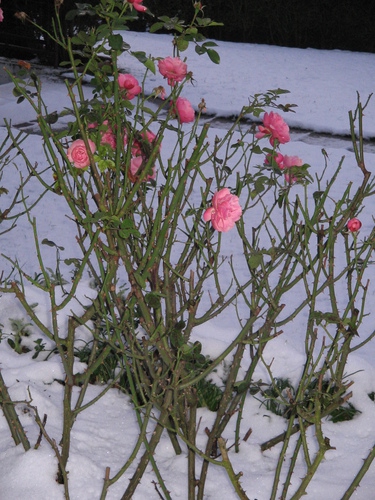
Roses, shrubs will be coated with soil during winter. The plant must have gone through some cold periods, to increase resistance. Therefore, the same work will not take place before finding November. Land located between the roses will be gathered around their roots without being touched. If there is not enough soil between plants will bring compost or peat. Roses climbing the walls will be covered with dry branches to reduce damage caused by large temperature differences when the sun shines in winter. The branches may be used instead of other materials that allow air to circulate.
If possible, roses trunk will be prostrate. The trunk will be released from support, tips of branches and buds will be cut and the crown will be brought to the ground, the trunk is bent over the grafting point. Bent in the opposite direction, it will break. It will be fixed to the ground, for example with a hook, and is then covered with earth. Crown will not be lying in a depression because there is a risk of accumulation of rain water or melted snow.

If the plant is too old to be lying down, crown and trunk will be wrapped with dry twigs, reeds or straw. All materials used to allow air circulation. Even if it is more convenient, the film should be avoided because it forms a true, greenhouse climate "which is bad for the plant.

Fertilizers for roses

Fertilizers for roses

Rose needs a lot of nutrients, but does not support large amounts of salts. Nutrients must be available in a balanced combination. If you miss even a single substance, the plant suffer from the disease of updates. The quantities required are not fixed, but depend on factors such as soil, climate and season. Nutrients should not be only available in the soil, but must appear in a form assimilable by plants.
Very important is soil pH. A pH of 7.0 indicates that the soil is neutral. Soils with higher pH soils are basic, others are acidic. Roses require a slightly acidic soil with a pH between 5.5 and 6.5. A pH change leads to other needed nutrients. The pH can be adjusted using various chemicals. The number of commercially available fertilizers is very high, their classification is very important.

Distinguished primarily organic fertilizers, the inorganic and the combined. Inorganic fertilizers, also known as organic fertilizers or artificial "are salts that are dissolved in the soil for plants is very easy. Their effect is short-lived. Besides the nutrients you need, these fertilizers can fill soil unnecessary substances that increase soil salinity. There fertilizer with a single active ingredient, with more nutrients or with a full spectrum of nutrients. The single nutrients are important in large spaces, in the garden, however, you should know the exact composition of the soil by chemical analysis.
Because roses are very sensitive to chlorine, the more nutrients fertilizers should select those which contain no chlorine, so-called fertilizer, and blue. " It should be borne in mind that not only their prices vary, but the chemical composition.


Fertilizers for roses


Organic fertilizers release nutrients into the soil from the decomposition of organic matter. Nutrients are slowly assimilated by the plant, but much longer periods. Bone meal or corn chips are good examples of organic fertilizers.
In order to combine the advantages of both categories, such as a long-lasting activity, but which quickly settle have been developed organic-mineral fertilizers. Many products labeled as,, fertilizing roses "belong to this category. Besides the price of the product should interest us advice on the packaging and fertilizer composition.
So-called fertilizer duration appear increasingly in trade offers. Through various chemical combinations, ensure a very long stream of nutrients dependent on temperature and humidity. Many crops require feeding only once a year when using these substances. Although more expensive than other fertilizers, they can be dosed accurately and are considered more environmentally friendly.

In planting the rose requires relatively few nutrients. If garden soil is of good quality and was prepared before planting, it is necessary to weight gain in that year. Regular administration of compost or cow manure with bone meal or corn chips, provide the best conditions for development. If necessary, a few weeks before planting can feed the soil with fertilizer for roses mixed.
When planting or immediately thereafter is strongly discouraged the use of fast-acting fertilizers, salts that are especially harmful in that period. Only when the plant is growing, they can be used in very small quantities. For the second year, a fattening ground is recommended. In the early period of growth, the rose will get around 100-150 grams of mixed fertilizer every square meter. Because some fertilizers have different concentrations and compositions, must be strictly observed quantities indicated by the manufacturer.

A second feeding of the soil takes place at the beginning of the second period of growth. Fattening effect of this should have been completed by the autumn. The use of mixed fertilizers, not those minerals. Autumn wood hardening can be stimulated by using a new fertilizer management, but it should not contain nitrogen, but especially potassium. Feeding roses spray is also recommended when possible and requires a very rapid effect, ie they lack a particular nutrient. Foliar fertilizer - as can be diluted to prevent leaf burn - will be sprinkled rose. Its concentration should be between 0.5 and 2% and treatment will take place in the evening or cloudy weather.
The lack of certain substances leads to typical manifestations of deficiency, easily recognized even by inexperienced gardener.

Maintenance roses

Maintenance roses

To grow beautiful and healthy roses we just need some knowledge required. The first measure is to remove the mound of earth spring after passing the first frost and growth shoots.
If appropriate, make and fattening ground. It will not break to shallow hoeing or young roots is best to pulling weeds around the plant. If you find that the soil is dry to wet thoroughly to help growth.
Should be followed and observed if there lastarele specific diseases (white spots on leaves - mildew, stains reddish - rust larvae pests etc.) When the roses are ill treated immediately with specific chemicals or natural substances (visit disease control), unless , preventive sprinkle of 14 to 14 days.